This week I read the second exploration pack. I think I learned a great deal about the history that lies behind the early tensions between China and many of the countries in the Western World (i.e. Britain). One of the more interesting connections that I saw between particularly chapter 5 and the “The Passion of Giuseppe Castiglione: How an 18th century Jesuit Painter Revolutionized Chinese Art” passage, written by Mathew Ehret-Kump was the effort that Qianlong put into the creation of “a multi-cultural Asian empire” (94) and the artistic avenue that he used to aid with this goal.
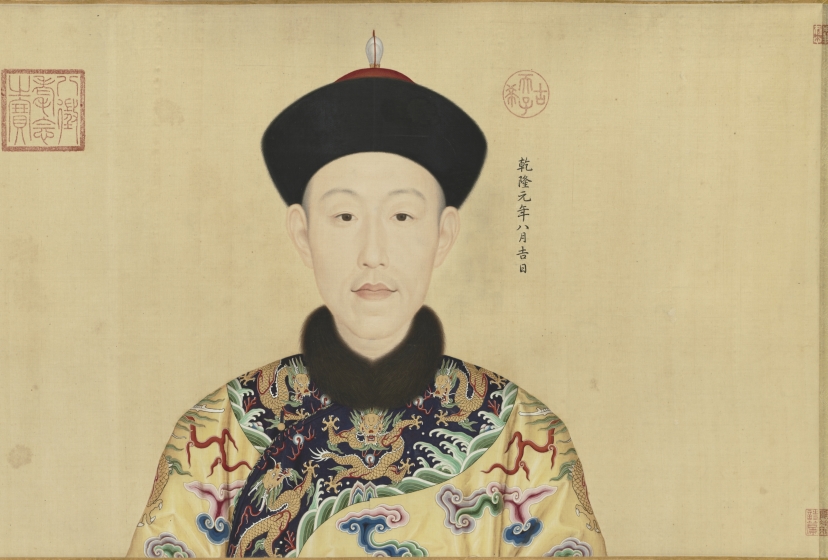
One of the portraits painted by Castiglione for Emperor Qianlong
With a Mom that has been a great fan of Chinese art, after living in Hong Kong for 5 years, I have come to appreciate many of the stories that these artists try to capture in their works. Reading this week’s exploration pack, I thought it was fascinating that in trying to reach the different cultural groups present within China at the time Qianlong used Castiglione and the avenue of art to illustrate not only his tolerance but his understanding of these different peoples. To me such an effort expressed his intelligence and understanding of power in a way that was not based around the mere use of force and the subjection of the people of China.
This understanding, willingness and acceptance of different cultures was contrasted however to what we saw in terms of his ‘foreign policy’ when he communicated with Western nations. This contrast was embodied with the interactions that Qianlong had with the British emissary about increasing trade between China and Britain (through India) when he explained that China had no need for barbarian products. Although this use of ‘barbarian’ as a label of Britain came from the tradition of the ‘Tribute of Yu’ and the five zones of China that placed the Emperor of China at the center of the world; it confused me a little as I thought that Qianlong would have been more open to the idea of foreign acceptance and amicable relations between different cultures. Lastly, as I write this, I want to make it clear that I do understand that there were many other factors that played into Qianlong’s limiting of trade between the two nations and that Qianlong’s mission to unite China was vastly different from foreign trade relations. This connection was merely a thought of mine.
Sources:
Ehret-Kump, Matthew. “The Passion of Giuseppe Castiglione: How an 18th century Jesuit Painter Revolutionized Chinese Art”. LA Review of Books, China Channel, January 17, 2019. URL: https://chinachannel.org/2019/01/17/castiglione/
Spence, Jonathan D. The Search for Modern China. Third ed. New York: W.W. Norton & Company, 2013.
