The Tiananmen Square massacre was an event of truly horrific nature. For many people when such an event is mentioned a particular photograph and man comes to mind. That photograph was taken by Jeff Widener. It captured a lone protestor (later named ‘Tank Man’), with a shopping bag in each hand, standing against a column of four tanks. This photograph for many encapsulates the events of Tiananmen Square as it illustrates the David versus Goliath like clash between the peaceful Chinese student and worker protestors and the Chinese military. This photograph when shown is often coupled with a video of the interactions between the man and these four tanks where the tanks try and maneuver around the man, but he continues to step in front of them until they all stop and turn off their engines. What comes after is almost more shocking as ‘Tank Man’ climbs the first tank to have a conversation with the men in the tank before climbing back down and being escorted away to the other end of the sidewalk by three men. There is much debate about who these men were that moved ‘Tank Man’ and whether they were members of the Chinese police or worried by-standers that wanted to save the protestor from certain death if he continued to interfere with the incoming tanks. After this photograph was taken however there has been no new knowledge about the fate of ‘Tank Man’ or the crew of the tank that stopped. Despite no new information coming to light about ‘Tank Man’ he is still recognized as a universal symbol of the Chinese civilian population that took a stand against the CCP that fateful day on June 4th, 1989.
The Tiananmen Square protests were led by many young Chinese university students, many of whom attended the University of Peking. The protests were aimed at instigating more democratic reform within the communist political system present within China. This call for reform came after the death of Hu Yaobang in April 1989 who was a leader that was considered to be pro-reform compared to many others in his party. The students protested on several occasions and were ignored, beaten and painted as villains who’s aim was to cause civil unrest. Despite all this however they continued to accrue the support of other students and workers. The students were, despite the propaganda that was published about them, organized and even outlined seven demands for reform. These of course were not accepted by the Deng Xiaoping, who was the head of the CCP at the time. On June 4th, with over 100,000 people protesting in Tiananmen Square Xiaoping decreed Marshall law and had the People’s Liberation Army march into the square firing discriminatorily into the crowds of people. By 5am the next morning the crowds had been dispersed. The Chinese government later came out stating that there had been 241 casualties in the dispersing of the protestors. This number is thought to be wrong as there have been many other estimates of the fatality count that range between 800 and 10,000.
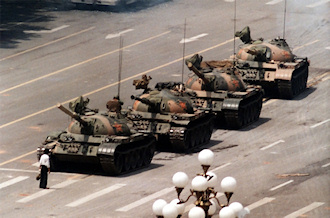
The freedom of the media is something that many, in America and other Western nations, are used to and enjoy without much conscious thought. This is not the same in China. In China the media and even much of what is published online is regulated and censored by the Chinese Communist Party. This censorship in combination with propaganda has been used in China for decades as a tool to suppress ideas of democracy and any form of rebellion/criticism of the government. A great example of this censorship is the photo of ‘Tank Man’ himself and how although considered by Time as one ‘The top 100 most influential photos of the century’ and by life magazine as one of ‘The 100 images that changed the world’ many of the younger generations of China today have not seen the photo nor heard much about it. In fact, one of the only reasons that we in the ‘West’ know much about the events of Tiananmen square was because of the large amounts of foreign press that were present in Beijing due to the arrival of Mikhail Gorbachev, who at the time was the President of the Soviet Union. In addition to this when listening to Widener talk to Time magazine, he discussed how many of those in the Chinese military were under the instruction to destroy any camera footage they could get their hands on. More specific to the ‘Tank Man’ shot itself Widener mentioned that on the balcony that he was shooting from there was a bullet hole just above his head that reminded him of the dangers of what he was doing if caught.
Today the image of ‘Tank Man’ and his stand against the column of tanks is a symbol of courage that has continued to be used and adapted. For many the image of ‘Tank Man’ and his stand was one that illustrated a final cry for humanity to be shown by the CCP. For others however it stood as a reminder to the Chinese Government that no matter their strength the Chinese people will stand for what is right even when it is in the face of certain peril. No matter the message that you take from the picture the image of ‘Tank Man’ standing against the row of tanks is one that will forever be immortalized. It is a symbol that will serve to represent the events of the Tiananmen Square massacre and those that stood for change and were violently beaten for their beliefs by the autocratic Chinese government and the CCP.
Sources:
Time Magazine. (n.d.). Tank man | 100 photographs | the most Influential images of all time. Retrieved May 12, 2021, from http://100photos.time.com/photos/jeff-widener-tank-man
Hubbert, J. (2014, November 10). Appropriating iconicity: Why tank man still matters. Retrieved May 12, 2021, from https://anthrosource.onlinelibrary.wiley.com/doi/full/10.1111/var.12042
